
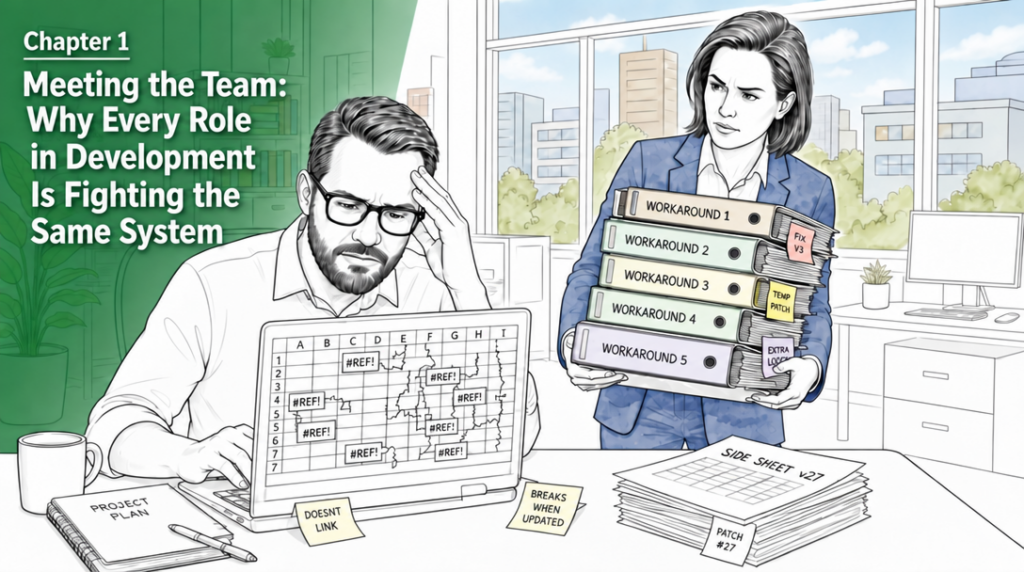
Picture a Monday morning at almost any real estate development company. The CEO is staring at three spreadsheets that do not agree with each other. The CFO is trying to explain why last week’s numbers, yesterday’s export, and this morning’s reconciliation all tell a slightly different story. The VP of Development cannot tell a general contractor whether the schedule can move up, because he does not know if the project is still within budget. The project manager cannot answer that question either, because he is waiting on the accounting team. The senior project accountant is buried in invoices from five different sources that do not talk to each other. And the technology leader is watching all of it happen on systems that were never built to work together.
None of these people are the problem. That is the point I keep coming back to after nearly four decades in real estate development accounting software. I have sat at the controller’s desk. I have prepared draw packages, managed cost codes, and reconciled intercompany accounts that should have reconciled themselves. I have listened to CEOs, CFOs, and project managers describe the exact same frustration in a hundred different ways. The people are talented. The people are working hard. The problem is what sits underneath them.
Six Roles, One Shared Problem
In my book, Looking Through the Windshield, I introduce six characters who work for a composite development organization: a CEO, a CFO, a VP of Development, a project manager, a senior project accountant, and a CIO. They are drawn from real people I have worked with across hundreds of organizations, from two-person shops closing their first deal to enterprises running multi-billion-dollar portfolios. I gave them names like Will Power and Paige Turner because a little humor makes the hard truths easier to sit with, but the challenges they face are not exaggerated for effect. They are the same challenges I hear about every week.
Between them, these six roles touch every piece of financial data that flows through a development company. The CEO needs to know, in real time, which projects will be profitable and when they will finish. The CFO needs to close the books, manage draws, and answer lender questions without three days of manual assembly. The VP of Development needs visibility into schedule and budget without waiting on phone calls and email chains. The project manager needs to spend his time managing the project, not managing data. The project accountant needs her coding to be trusted, not re-checked. And the technology leader needs systems that actually talk to one another.
In smaller companies, one person often wears three or four of these hats at once. The owner is also the project manager. The controller is also the accountant answering investor questions. That does not make the challenge smaller. It just concentrates it into fewer people carrying more weight.
Why the Tools Are the Real Culprit
Here is something I have watched play out for nearly forty years: real estate development is one of the more financially complex undertakings a business can attempt, and most companies manage that complexity with tools built for something else entirely. General-purpose accounting software. Spreadsheets. Institutional knowledge held together by a few indispensable people who have not taken a real vacation in years.
The Northspyre team, whose research into commercial real estate technology adoption echoes a lot of what I have seen firsthand, has documented this same dynamic from a slightly different angle. When accounting departments become the default owners of project data, because nobody built a system where developers can access it directly, the entire organization slows down. Developers wait for accountants to pull reports. Accountants get pulled away from reconciliations and compliance work to answer status questions that should take thirty seconds. Everyone ends up managing the system instead of managing the business.
It works, until it does not. It works when you have two projects and a controller who has memorized every workaround. It stops working at five projects. By ten, most companies are operationally strained in ways that have nothing to do with the quality of their people and everything to do with the architecture underneath them.
People, Process, Platform
I have a framework I return to in every conversation about this, because it is refreshingly simple and it happens to be true: People, Process, Platform. Always in that order. Always treated as one idea, not three separate initiatives.
Your people are probably good. That is rarely the actual issue. The real question is whether your Process and your Platform let those people see what they need to see, when they need to see it, so they can act instead of react. Without the right accounting architecture and the technology to support it, even your best team is flying blind. With it, they have real visibility, and visibility is what turns good people into a team that produces predictable, profitable outcomes.
That is the difference between looking in the rearview mirror and looking through the windshield. Looking in the rearview mirror means managing what already happened: costs already paid, periods already closed, reports generated after the fact. It is reactive, and in development, reactive is expensive. By the time a problem shows up in a report, the money to fix it is often already spent. Looking through the windshield means knowing your Cost at Completion at 25 percent finished, when you still have room to act. It means giving your investors a live report instead of a reconstruction, and giving your project managers the information they need in the field, not three days later.
Where This Goes Next
The six people you meet in Chapter 1 of my book are not the last time you will see them. Every chapter that follows builds the specific pieces of architecture that let Will, Robin, Jim, Marc, Paige, and Phil stop assembling data and start using it. If you want to see how the foundation gets built, start with how a development portfolio’s legal structure connects to its accounting structure in Multi-Entity Accounting: Building the Structural Backbone Your Portfolio Depends On. And if you want to see what all of this eventually adds up to, once every pillar is working together, jump ahead to Seeing the Whole Picture, which describes what a Monday morning looks like once the architecture actually works.
The scale of your company will change over time. The number of projects will grow. The number of stakeholders asking for answers will grow faster. But the core need never changes: the right information, for the right person, at the right moment. That is not a technology slogan. It is the whole job.
Greg Daniele is the author of Looking Through the Windshield: The Ultimate Guide to Real Estate Development Accounting Software, drawing on nearly 40 years building financial systems for real estate developers. Learn more at realestatedevelopmentaccountingsoftware.com.