
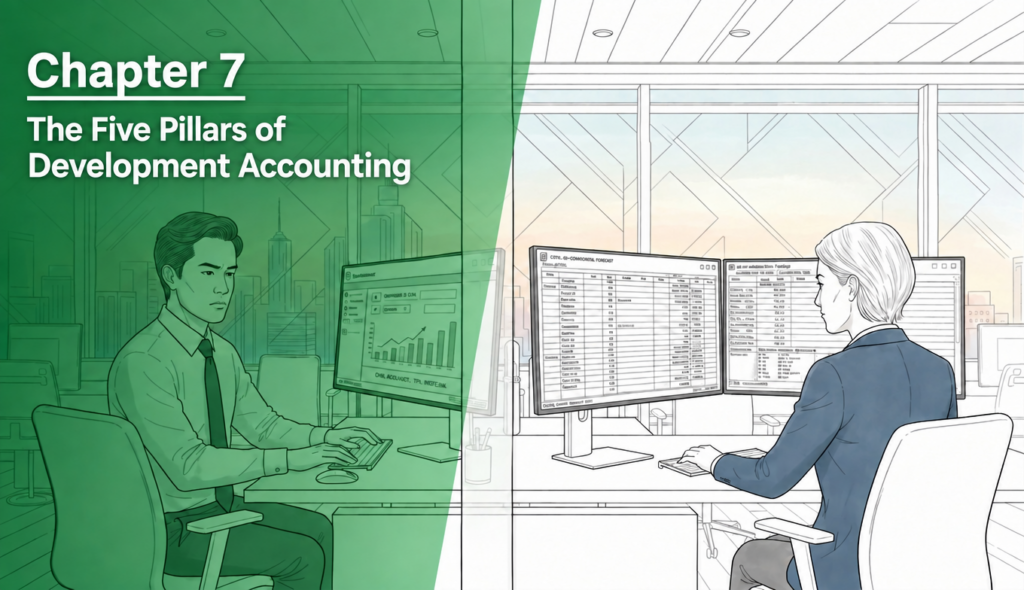
A CEO is reviewing a project on his screen. Everything looks organized. One point nine million dollars spent so far, contacts and notes all in one place. His business partner walks in with a question that cuts straight to what actually matters: I know what we have spent. But what have we actually promised to spend under contract? And more importantly, where are we really going to end up?
That question exposes the limit of tracking any single number in isolation, and it is the reason I built the second half of my book around what I call the Five Pillars of Development Accounting. Most developers already track some version of these things. Maybe budget versus actual. Maybe commitments buried in a contracts folder. Maybe loan draws managed by muscle memory. Partial visibility is exactly where the danger lives, because it lets you feel confident right up until the moment you discover you were wrong.
What Partial Visibility Actually Hides
Here is a real example. At month eight of a project, the numbers show four point eight million dollars budgeted, one point four million spent to date. That is 30 percent of budget with a third of the timeline gone. Looks fine. But that view is missing two point four million dollars in signed commitments, a third of which has not even been invoiced yet. It is missing a hundred thousand dollars in direct costs like legal and permitting fees that never touch a formal contract. It is missing three pending change orders totaling sixty thousand dollars that are not approved but are very real risks. And it is missing the fact that the loan budget only covers a fraction of the true projected cost, leaving a funding gap nobody flagged until it was already a problem.
Add it all together, and the picture changes completely. You thought you were looking through the windshield. You were only seeing part of the road.
The Five Pillars, Working Together
Budgeting is your financial roadmap, built from three versions working in concert: an Original Budget that never changes once locked, a Revised Budget that reflects every board-approved change, and a Forecast Budget that captures what your project managers see coming before it is official. Commitments show you what you have promised to pay, not just what has been invoiced, closing the dangerous gap between a signed contract and the bill that eventually follows it. Cost-to-date and period cost show what has actually been incurred, broken into what is paid, what is owed, and what is withheld in retention. Cost at Completion pulls all of that together into the single most important number in the entire discipline: based on everything you know today, where is this project actually going to finish? And Loan Draw Management makes sure that whatever your Cost at Completion tells you, you can actually fund it, on schedule, in the format your lender requires.
Each pillar matters on its own. The real value shows up when all five live in one connected system, because every dollar on a project moves through the same lifecycle: it starts as a budget line, becomes a commitment when a contract is signed, becomes a cost when the invoice arrives, and gets paid through a loan draw. When all five pillars share the same underlying data, that lifecycle is visible at every stage, and everyone from the field to the boardroom is looking at the same number instead of reconciling five different versions of the truth.
Choosing a Platform That Can Actually Hold All Five
This is where the conversation has to move from framework to implementation, because a spreadsheet cannot hold five interconnected, real-time pillars no matter how carefully it is built. What you need is a platform where budgets, commitments, direct costs, Cost at Completion, and loan draws are built into the same database from the start, not stitched together through exports and manual transfers.
I spent years as a reseller for Acumatica (https://www.acumatica.com), a cloud ERP platform whose flexible, connected architecture makes this kind of unified system genuinely achievable, provided it is configured specifically for how real estate development actually operates rather than deployed as a generic accounting package. That configuration work is not incidental. It is the whole game. Firms like Elevate Solutions (https://www.elevatesolutionsre.com) specialize in building out the real estate-specific screens, dashboards, and reports on top of platforms like Acumatica, which is exactly the kind of specialization I argue for throughout this book: not just technology for its own sake, but technology shaped to fit the way development actually works, rather than a business contorting itself to fit generic software.
Set up all five pillars before your first transaction posts on a new project. Adding commitment tracking halfway through means going back and manually entering every contract you already signed, which is far more painful than doing it right from day one. Keep your Forecast Budget genuinely current, because a forecast that has not been updated in six weeks is not an early warning system. It is just noise pretending to be data.
Five Chapters, One Continuous Story
Over the next five pieces in this series, I go deep into each pillar individually: Pillar 1: Budgeting, Your Financial Roadmap, Pillar 2: Commitments, Pillar 3: Cost-to-Date and Period Cost, Pillar 4: Cost-at-Completion, Your Destination, and Pillar 5: Loan Draw Management, Funding Your Vision. Each one builds on the cost code foundation from Cost Codes: The Language of Project Financial Control, because none of these pillars work without a consistent language underneath them.
When your system understands all five pillars together, your team stops being data assemblers and starts being decision-makers. That is the actual shift this book is about. Not faster reports for their own sake, but the difference between managing what already happened and managing what is happening right now, while there is still time to change the outcome.
Greg Daniele is the author of Looking Through the Windshield: The Ultimate Guide to Real Estate Development Accounting Software. Learn more at realestatedevelopmentaccountingsoftware.com.